Archive for enamel

Place as Landscape / Place as Concept: Contemporary Enameling in the U.S.


We are delighted to announce the exhibit “Place as Landscape/Place as Concept: Contemporary Enameling in the U.S,” from January 15 – March 8, 2019.

Please join us for the opening reception on Saturday, February 2 at 2pm.

Mounted in conjunction with Richmond Arts Center, the exhibit examines the idea of place from an American perspective.

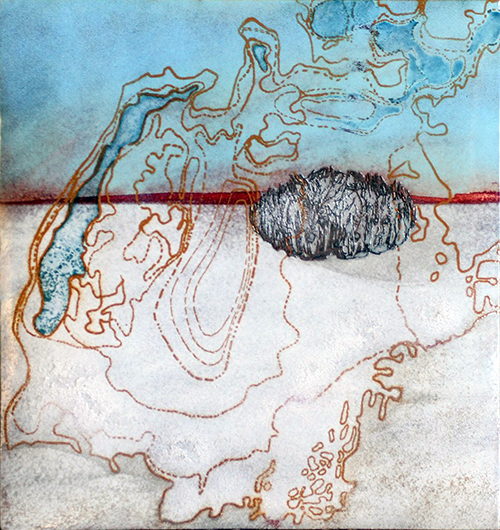
These works in enamel–by established and emerging artists alike, using a range of traditional and experimental techniques–explore place as as a way of understanding who we are. By turns complex, conflicted, melancholy, and beautiful, these images and objects show us our country as well as ourselves.

This exhibition expands upon the American showcase presented at BLAZE: International Contemporary Enamel Exhibition at the National Taiwan Craft Research and Development Institute in Taipei (May-August, 2018).

Artists: Ken Bova, Harlan Butt, Katy Cassell, Kat Cole, Helen Elliott, Danielle Embry, Greg Flint, Kristina Glick, Gretchen Goss, Janly Jaggard, Sarah Loch-Test, Sharon Massey, Cynthia Miller, Pat Musick, Gail Reid, Rene Roberts, Averill Shepps, Jan Smith, Judy Stone, Don Viehman, Carly Wright

For press inquiries and images please contact the Center for Enamel Art at info@enamelcenter.org.

Image: Katy Cassell, Lost Sea, 2016. Enamel, copper, reflective glass beads, mounted to wood.

Surface, Color, Form: We Talk With Kathryn Osgood About Her Boundary-Pushing Work

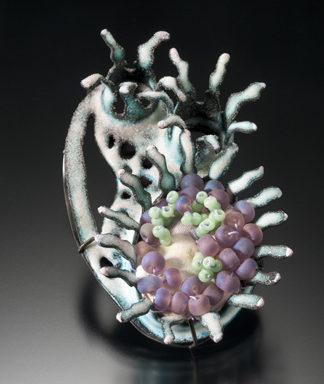
Brooch, Kathryn Osgood

Kathryn Osgood worked as an engineer for a small, family-owned telephone company in rural Maine for almost 20 years before starting a second life as an artist, jeweler, and enamelist. After studying with Linda Darty and Bob Ebendorf at East Carolina University, she moved to the Outer Banks of North Carolina, where she heads the Professional Crafts Jewelry Program at College of The Albemarle in Manteo

Osgood’s work pushes the boundaries of enameling, using fold-forming, varied surfaces, and non-traditional materials to create tactile, sculptural pieces. Osgood will share her expertise in her upcoming workshop, Enamels: Exploring Texture, Color and Form. The workshop runs from May 18 – May 20, 2018, at the Crucible in Oakland, CA.

There are still slots available in this workshop–register now!


What drew you to enamel as your preferred medium?

I have always loved color. It elicits an emotional response from the viewer; it can be calming, sensual, exciting, joyful. Before I became a jeweler and enamellist, I was working as a textile artist, doing surface design, painting and dyeing fabric and creating wall hangings and quilts. When I took my first metals class, I was hooked. I loved working with metal; how it allowed me to create dimensional work. It could be hammered, shaped, and formed.  I fell in love with the material, but I really missed the element of color.

When I discovered enamel, I found a way to bring color back into my work. Layering opaque and transparent enamels allows me explore an almost unlimited rich color palette.
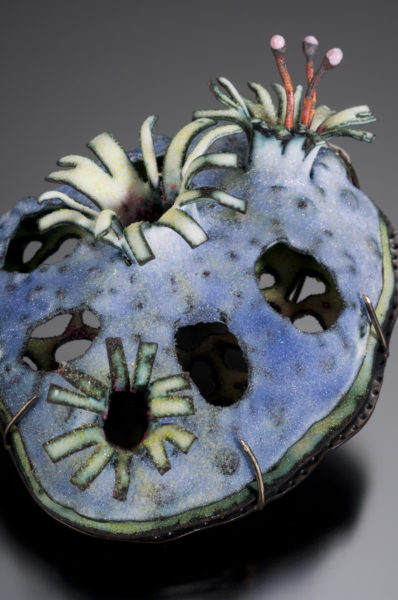
Ocean Brooch, Kathryn Osgood

How did you become intrigued with textured dimensional surfaces?

When I began working with metal and was fabricating jewelry from sheet metal, I was not satisfied with the idea of decorating a flat surface.  I wanted to create pieces that were more sculptural, to take advantage of the plasticity of metal, of its ability to be formed into organic shapes.  I began exploring the natural forms around me: magnolia pods, pine cones, leaves.  I was intrigued by the textures found in nature and I wanted to replicate them, creating pieces that were more organic.

I enjoy exploring ways to from metal by hammering, dapping, bending, fold forming, shell forming, and die forming.  I like my pieces to have a tactile quality, to invite the viewer to touch.  I want them to feel good, to entice with both texture and color.

Who have been your mentors?

There are so many talented enamelists whose work inspires me, so it is hard to just name a few.

I was lucky enough to study at East Carolina University with Linda Darty and Bob Ebendorf.  Linda Darty introduced me to enameling and the world of color on metal. Linda is a master enamellist and she generously shared her extensive knowledge of enameling and was a supportive and encouraging teacher. Linda continues to impress me with her beautiful work and with her love for the art of enameling. Bob Ebendorf is also a mentor and generous teacher. His knowledge of metalsmithing and his adventurous creative spirit continue to inspire me in living a creative life.

Osgood on the North Carolina coast

What inspires your work?

I live on Roanoke Island, off the coast of North Carolina. Since moving to the Outer Banks area, my work has changed to reflect my environment. The colors and textures of the sand and the water that surround my coastal home inform my work. In the early mornings, I often walk on the beach with my dog, Lola, picking up pieces of shells and driftwood that have washed in with the tide.  My pieces are based on marine plant and animal forms, their textures and colors informed by the shell fragments that I have collected.

 Find more of Osgood’s work on her website.

The New Aesthetics of Enamel

Quick: If I told you I’d bought an enameled pendant, what would come to mind? Something clumpy and heavy, with garish colors? Maybe a small, jewel-toned piece, carefully polished?

Enamel is a highly technical art form often taught as a craft. Like many crafts, it has been vulnerable to having a few specific aesthetics baked into it (so to speak). Work taught in jewelry or metalworking departments was often small, using cloisonne and champleve, layers of transparent jewelry enamel to create controlled, gem-like colors and effects.

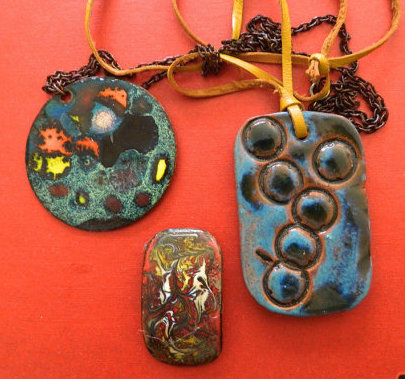
Enamel got looser in the 50s and 60s, when kitchen-table enamelists, using small home kilns and glass threads and chunks, produced a burst of tiny Abstract Expressionist-ish works that had a more primitive, modern aesthetic than the work by their highly trained counterparts.

But the pieces were still small, still usually jewelry, and limited by the scale of the supplies and the equipment. The aesthetic became a cliche.

Since then, though, a shift has occurred, as enamel is taught less as a craft and more as part of the vocabulary of art. It is attracting artists who are discovering the terrific potential of enamels purely in service of visual ideas.

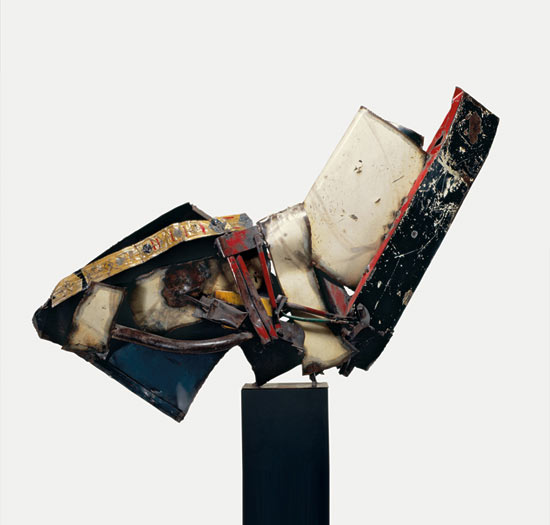
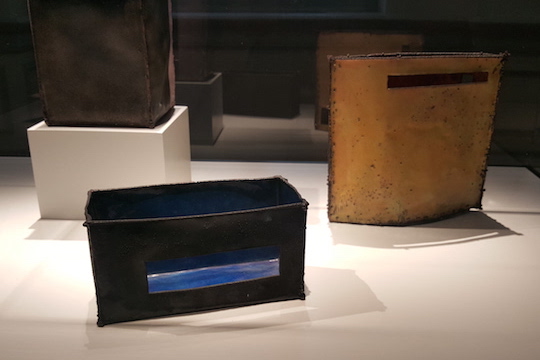
Take these works, for example, by British artist Lisa Traxler, for whom vitreous enamel on steel is just one of several media she works in. With their scale, volume, and attention to line and color, these are like three-dimensional paintings. They have more in common with the crushed metal sculptures of John Chamberlain than Faberge’s precious eggs.

Volume Sculpture A,F, C and D, vitreous enamel on metal, gallery installation view

Zaar, by John Chamberlain, painted steel, 130cm x 174 x 50cm

More work by Lisa Traxler here.

June Schwarcz, of course, was one of the original pioneers of enamel in service of art. She exploded the possibilities of jewelry enamel into pure form and color.

Works from Invention and Variation, at the Renwick Gallery, June Schwarcz’, summer 2017

This Latvian artist has created large images from smaller copper pieces, much like enamelist Fred Ball.

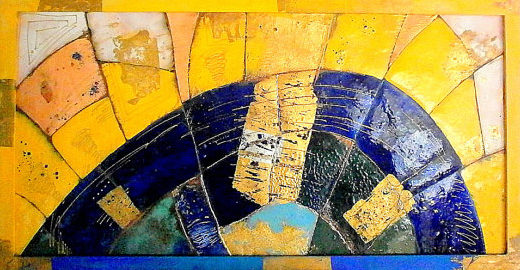
Contrast, enamel on copper, 49″W x 26″H, by Lion Dina

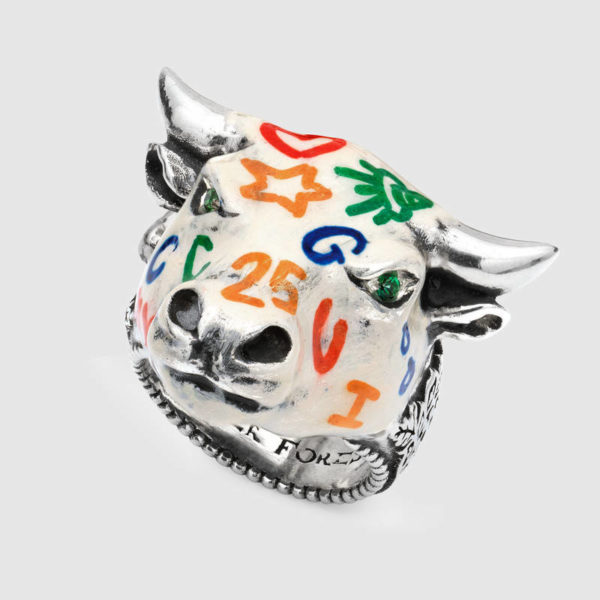
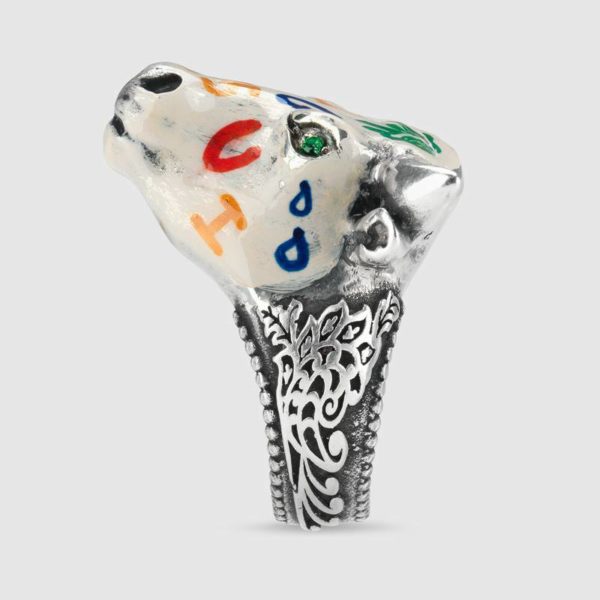
And now back to jewelry: We are starting to see mainstream work that uses enamel for its rich color and permanent quality, but that strays from traditional techniques into a style that is more free, more inspired by visual art, as with this enameled silver ring from Gucci.


Do you have work that pushes the boundaries of the old enamel aesthetic? Show us! at blog@enamelcenter.org.

T Magazine Features Enamelwork — Without Using the Word Enamel


https://nyti.ms/2yJ7UDA

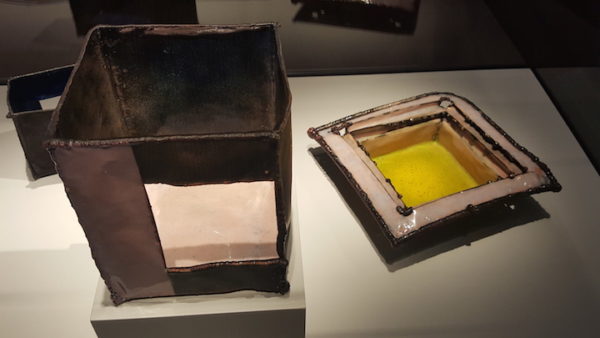
The good news is that the latest issue of T Magazine has a lush spread devoted to enameled jewelry and objects new and old. (Click here to read the article.) The luminous boxes of Jean Goulden rub shoulders with the incredible miniature artworks that are Alice Cicolini’s rings and Morelli’s meditation bells.

It’s interesting, though: In the print edition, there’s no mention of the word “enamel.” The text reads, in full: “Through the Looking Glass: An ancient technique gets a new shine when applied to contemporary jewelry and objets.” (The online version has the more Google-friendly (and accurate) header, “Enamel Adds A New Shine to Small Accessories.”)

The photographs are pretty — still-lifes in dusty jewel-tones, the items scattered on shabby-chic dressing tables as though tossed there at the end of some fabulously debauched evening. Care has been taken with a whimsical mix of props –a bowl of candies, lipstick on a wine glass, vintage hotel keys. But the pieces themselves are lost in the scenery, an afterthought, the details and the colors almost too small to see. And those vintage aqua colored Belperron earrings, that pop so nicely on the page? They are made of turquoise and lacquer, says the website. Not enamel.

Just saying. We’re delighted enameled work is getting such prominent billing. And we’ll be even more delighted when everyone knows its name.

Tools and Supplies: A Conundrum, Part 1

Here is a conundrum: If vitreous enamels, and related tools and supplies, aren’t readily available, people can’t enamel.  If people can’t enamel, suppliers can’t sell supplies.  This chicken-and-egg problem is a huge obstacle for the growth of enameling in the U.S. and worldwide. How do people who use vitreous enamel deal with this conundrum? How does it shape enameling today, and how will it affect enameling’s future?

Share the Heat is pleased to announce a series of blogposts about tools and supplies for the enameling community. We will be examining the state of supply availability in interviews with several small independent U.S. suppliers, including Coral Shaffer of Enamelwork Supply, and Scott Ellis of e-namels.com. We will also be posting insider tips on how to find supply resources.

  • Part 1 of this introduction will give a little background and recent history in order to put the tool/supply conundrum into perspective. It will focus on why supplies, especially enamel powders  are not easy to find; why there is not much diversity in enamels that are available for sale; and why quality and customer service are sometimes problematic.
  • Part 2 will be about industrial enameling supplies and tools specific to enameling, such as firing  and application tools.
  • Part 3 will focus on how the internet has changed availability and information about supplies and supply sources.

The Center for Enamel Art is committed to helping enamelists in their professional development. We believe strongly in the sharing of resources of all kind. We hope that this series of posts begins a much-needed discussion about one problem that has hindered the growth of enameling as a recognized art medium.


Where have all the manufacturers gone?

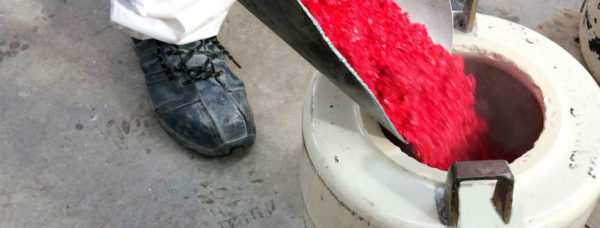
putting enamel in a ball mill

Before Thompson

First, let’s look at the evolution of enameling in the U.S. over the last hundred years.  Read More →